Myrtle Keeton's murder
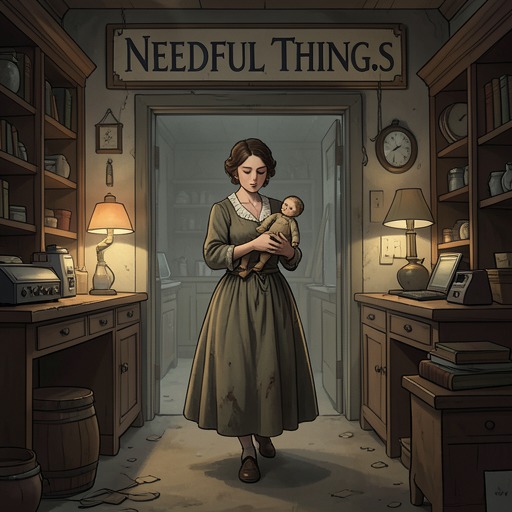
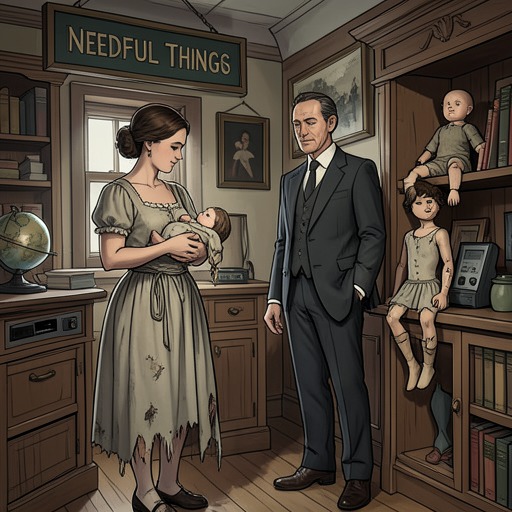
Needful ThingsMyrtle Keeton’s murder is the point at which Danforth Keeton’s private collapse becomes irreversible violence. His gambling losses and embezzlement had already entangled his public office with his personal desperation; after killing Myrtle with a hammer, he is left not triumphant but exhausted, aware that even his prized Winning Ticket cannot undo what he has done.
Causes and Background
Keeton’s gambling began with losses he concealed from Myrtle. After losing $160 at the track, he returned to recover the money and lost another $210. To cover the resulting shortfall in the checking account, he took $100 from the town petty-cash fund. The initial misappropriation became a downward slide: he later used a bookie to place larger bets, but his luck did not improve.
By the autumn of 1990, the records and correspondence that Keeton had kept hidden were beginning to unravel. He stored the Bureau of Taxation letters in a locked filing-cabinet drawer and sorted them separately from his own replies. Although the replies bore the initials of his secretary, Shirley Laurence, she had not typed them. The coming state audit threatened to examine all the town’s books, from tax and revenue-sharing records to municipal budgets and the experimental tree farm’s finances. One warning slip naming embezzlement brought the concealed financial wrongdoing into the immediate domestic space.
The murder follows this material crisis amid Keeton’s increasingly persecutory fear. The evidence identifies him as already convinced that the town was against him, but the aftermath shows that this conviction does not shield him from recognizing the central fact: he has killed his wife.
What Happens
After Myrtle’s death, Keeton falls into a deep fugue. His sense of purpose gives way to weariness and depression, and he notices the hammer still in his hand. He releases it and studies the mark left on the kitchen floor, seeing in it an image of his father’s face. The moment links the immediate crime to a past that remains present in Keeton’s perception, without making that association an explanation or excuse for the killing.
He then goes to his study, where he retrieves the box for Winning Ticket, the mechanical horse-racing game he had hidden in the closet. The handcuff chain he is wearing catches on one of Myrtle’s shoes as he crawls out. Rather than feeling the excitement the game once promised, he sits with the box and recognizes that replacing the stolen money would not alter the fact of the murder. His justification that Myrtle had deserved it is immediately set against his certainty that the authorities would not accept that defense.
Delay and Immediate Aftermath
Keeton removes his bloody clothes, showers, changes, and returns to the study. Nearly twenty minutes pass between Myrtle’s murder and his trip through the house to the shower. He might have been taken into custody during that interval, but the sheriff’s office is in disarray during a transition of authority, and his whereabouts do not seem important to those managing the disruption.
Back at his desk, Keeton looks again at Winning Ticket, hoping his earlier pleasure will return. Instead, the picture on the box seems dulled, with Myrtle’s blood marking the pictured horse. Inside, the little tin horses lean out of place, their colors faded, and a broken spring protrudes from the winding hole. The game that had fed his gambling hopes is left visibly damaged, an object that now mirrors the collapse of the future he had imagined for it.
Consequences and Significance
The murder converts Keeton’s fear of exposure into a completed crime, while making his earlier pursuit of money appear futile even to himself. Winning Ticket had once seemed capable of repairing his finances; after Myrtle’s death, Keeton understands that repayment cannot reverse the act. His post-crime depression and attention to the broken toy register the difference between the imagined solution of a winning bet and the consequences he cannot gamble away.
The scene’s progression is deliberately stark: violence is followed not by escape or renewed purpose but by a fugue, a shower, and the return to a gambling toy that has lost its allure. Keeton’s claim that Myrtle deserved the murder remains his own rationalization, immediately overshadowed by his expectation of punishment. The institutional confusion buys him time, but it does not erase his awareness of responsibility or restore the value he had invested in Winning Ticket.